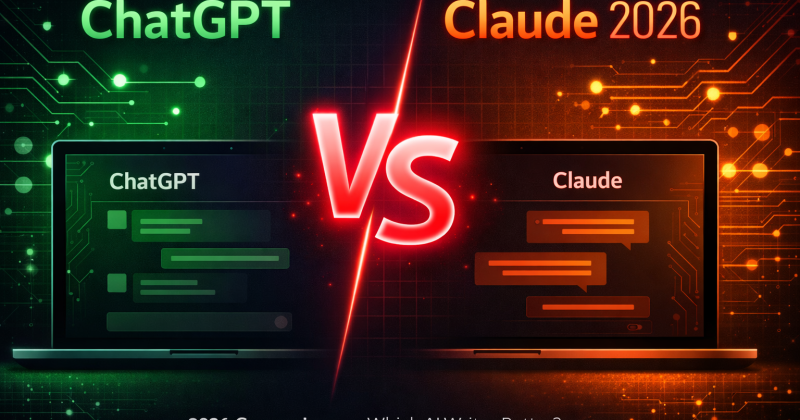
Two AI giants. One decision. ChatGPT vs Claude is the most common dilemma writers face in 2026 — and for good reason. Both tools are free to start, both cost $20/month for premium, and both produce remarkably good content. But after testing them side by side on identical writing tasks for two weeks, the differences became impossible to ignore. This ChatGPT vs Claude comparison breaks down exactly where each one wins, where it loses, and which one deserves your $20.
ChatGPT vs Claude — Quick Comparison Table
Before diving into details, here’s a snapshot of how these two AI writing tools stack up against each other in March 2026.
| Feature | ChatGPT | Claude |
|---|---|---|
| Developer | OpenAI | Anthropic |
| Latest Model | GPT-5.2 (Feb 2026) | Claude 4.6 Opus (Feb 2026) |
| Free Plan | Yes — GPT-5.2 with limits | Yes — Sonnet 4.5 with limits |
| Paid Price | $20/mo (Plus) / $200/mo (Pro) | $20/mo (Pro) / $100-$200/mo (Max) |
| Context Window | 128K tokens | 200K tokens (1M beta on Opus 4.6) |
| Writing Quality | Good — clear and structured | Excellent — natural and human-sounding |
| Best For | Versatility, research, brainstorming | Long-form writing, tone matching, creative content |
| Web Search | Built-in browsing | Built-in web search |
| Image Generation | DALL-E built-in | Not available |
| Video Generation | Sora (on Plus/Pro) | Not available |
| Custom Assistants | Custom GPTs | Projects + Custom Styles |
| Code Execution | Built-in Python sandbox | Built-in code execution |
| File Uploads | Yes — docs, images, PDFs | Yes — docs, images, PDFs |
| Weekly Active Users | 700M+ (mid-2025 data) | 18.9M+ professional users |
What Is ChatGPT in 2026?
ChatGPT needs little introduction. OpenAI’s flagship product has grown from a viral experiment in 2022 to the world’s most widely used AI tool, with over 700 million weekly active users as of mid-2025. In February 2026, OpenAI retired all older models (GPT-4o, GPT-4.5) and moved everything to the GPT-5.2 family — a significant upgrade in reasoning, speed, and output quality.
The free tier now runs on GPT-5.2 with a cap of roughly 10 messages every 5 hours, after which it drops to GPT-5.2 Mini. OpenAI also introduced a new Go plan at $8/month for light users, while the Plus plan remains at $20/month with access to GPT-5.2 Thinking (the reasoning model), Sora video generation, DALL-E image creation, and custom GPTs. The Pro plan at $200/month removes virtually all limits and adds the powerful o1 Pro mode for complex research tasks.
One notable change: OpenAI started testing ads on the Free and Go tiers in February 2026. Plus and Pro remain ad-free. This alone may push some free users toward Claude, which currently shows no ads on any tier.
What Is Claude in 2026?
Claude is built by Anthropic, a company founded by former OpenAI researchers. While it doesn’t have ChatGPT’s massive user base, Claude has carved out a loyal following among writers, developers, and professionals who care deeply about output quality. With 18.9 million professional users, it’s the second most popular AI assistant globally.
The big news in February 2026 was the release of Claude 4.6 Opus — Anthropic’s most powerful model yet. It features a 1 million token context window (beta), 128K max output tokens, and leads coding benchmarks with an 80.9% score on SWE-bench Verified. The free plan runs on Claude Sonnet 4.5, which is the same model powering most paid interactions — so free users aren’t getting a watered-down experience, just tighter limits.
Anthropic also expanded the free tier significantly in February 2026, giving non-paying users access to Projects, Artifacts, and basic app connectors. The Pro plan at $20/month adds 5x usage, Claude Code (terminal-based coding agent), Google Workspace integration, and Extended Thinking for complex reasoning. Max plans at $100 and $200/month offer dramatically higher limits for power users.
ChatGPT vs Claude — Writing Quality Tested
This is the comparison that matters most for writers. We gave both tools identical prompts across four content types and evaluated the output without editing.
Blog Post Introduction (500 words)
Prompt: “Write a 500-word blog introduction about the benefits of remote work in 2026.”
ChatGPT’s output was well-organised with clear topic sentences, logical paragraph flow, and good use of statistics. The writing was competent but had that recognisable AI polish — slightly formal, perfectly structured, and a bit predictable. It read like a well-written corporate blog post.
Claude’s output felt noticeably more natural. The sentences varied in length and rhythm. It used conversational transitions that sounded like a real person thinking through their argument. The content was equally well-researched but delivered with more personality and fewer of those telltale AI writing patterns (like starting paragraphs with “Moreover” or “Furthermore”).
Winner: Claude — The writing quality gap is real and consistent. Claude produces content that requires less editing to sound human.
Product Description (200 words)
Both tools performed well here. ChatGPT was slightly punchier with its copywriting hooks, while Claude wrote more nuanced descriptions that felt less salesy. For marketing copy, ChatGPT has a slight edge. For product descriptions that need to sound authentic, Claude wins.
Winner: Tie — depends on the tone you’re targeting.
Cold Outreach Email
ChatGPT produced a perfectly structured cold email with a strong subject line and clear call to action. Claude’s version felt more personal — like someone actually wrote it rather than templated it. The personalisation touches were more natural in Claude’s output.
Winner: Claude — for emails that need to feel genuinely human.
Long-Form Article (2,000+ words)
This is where the gap widens dramatically. ChatGPT’s long-form output starts strong but tends to become repetitive after 1,000 words. Transitions get formulaic, and the AI starts recycling ideas with different wording. Claude maintains consistency, variety, and depth throughout the entire piece. With its 200K context window (1M on Opus 4.6), Claude can hold the entire article in memory and ensure coherence from start to finish.
Winner: Claude — decisively better for long-form content.
If writing quality is your top priority, Claude wins in 3 out of 4 categories. ChatGPT holds its own for short-form marketing copy and structured outlines. It also leads in AI image generation — see our best AI image generators 2026 ranking for details, but Claude’s output consistently sounds more natural and needs less editing. For anyone producing blog posts, articles, or content that needs a human touch, this distinction matters.
ChatGPT vs Claude — Features Beyond Writing
Writing quality is just one part of the equation. Both platforms offer features that extend well beyond text generation.
| Feature | ChatGPT | Claude |
|---|---|---|
| Image Generation | DALL-E built-in — generate images from text | Not available |
| Video Generation | Sora — create short videos (Plus/Pro) | Not available |
| Web Browsing | Built-in — real-time search | Built-in — web search added |
| Custom Assistants | Custom GPTs — share with others via GPT Store | Projects + Custom Styles — personal only |
| Voice Mode | Advanced voice with natural conversation | Not available (text only) |
| Code Execution | Python sandbox built-in | Code execution built-in |
| Coding Agent | Codex — cloud-native coding agent | Claude Code — terminal-based coding |
| Google Workspace | No native integration | Reads/edits Docs, Gmail, Drive on Pro |
| File Analysis | PDFs, docs, images, spreadsheets | PDFs, docs, images, spreadsheets |
| Desktop App | Available for Mac/Windows | Available for Mac/Windows |
| Plugin Ecosystem | Massive — thousands of GPTs | MCP connectors (growing) |
ChatGPT wins on versatility. If you need one AI tool that handles text, images, video, voice, and code — ChatGPT is the only option that does it all. The Custom GPTs ecosystem alone gives you access to thousands of specialised assistants for every conceivable task.
Claude wins on depth. While it can’t generate images or video, it compensates with superior writing quality, a massive context window, Google Workspace integration (directly edit your Docs and Gmail from inside Claude), and Claude Code for developers. If your work is primarily text-based, Claude’s focused approach delivers better results.
ChatGPT vs Claude — Pricing Breakdown (2026)
| Plan | ChatGPT | Claude |
|---|---|---|
| Free | GPT-5.2 (10 msgs/5hrs, ads) | Sonnet 4.5 (~9 msgs/5hrs, no ads) |
| Budget Paid | Go — $8/mo (unlimited GPT-5.2 Instant) | No equivalent tier |
| Standard Paid | Plus — $20/mo (GPT-5.2 Thinking + Sora + DALL-E) | Pro — $20/mo (5x usage + Claude Code + Google Workspace) |
| Power User | Pro — $200/mo (unlimited everything + o1 Pro) | Max — $100-$200/mo (5x-20x Pro capacity) |
| Team | Business — $25-30/user/mo | Team — $25-30/user/mo |
At $20/month, both Plus and Pro offer exceptional value. The choice comes down to what you value more: ChatGPT’s broader feature set (images, video, voice, massive GPT ecosystem) or Claude’s superior writing quality and deeper Google Workspace integration.
ChatGPT has one advantage Claude lacks: the $8/month Go plan. If you need unlimited basic AI access without premium features, there’s no Claude equivalent at that price point.
ChatGPT vs Claude — Who Should Choose What?
Choose ChatGPT If You…
Need an all-in-one AI tool. Writing, images, video, voice, code — ChatGPT handles everything. If you don’t want to switch between multiple tools, ChatGPT is the most complete package available.
Do heavy research and brainstorming. ChatGPT’s web browsing, Deep Research feature (on Pro), and massive plugin ecosystem make it unbeatable for gathering information and generating ideas.
Want a budget option. The Go plan at $8/month has no Claude equivalent. And the free tier, despite ads, still provides access to GPT-5.2.
Create multimedia content. Bloggers who need featured images (DALL-E), short videos (Sora), and written content from one platform should pick ChatGPT without hesitation.
Choose Claude If You…
Prioritise writing quality above everything. Claude consistently produces the most natural, human-sounding text of any AI tool available in 2026. If your reputation depends on the quality of your writing, Claude is the safer bet.
Work with long documents. Claude’s 200K context window (1M on Opus 4.6) means it can process entire books, research papers, or lengthy reports in one go. ChatGPT’s 128K window is generous but smaller.
Need Google Workspace integration. Claude Pro can directly read and edit your Google Docs, Gmail, and Drive — no copy-pasting required. This is a genuine productivity advantage for anyone living in Google’s ecosystem.
Write professionally for clients. Freelance writers, content agencies, and anyone producing content where “sounding like AI” is unacceptable should lean toward Claude. The editing time saved pays for the subscription.
ChatGPT vs Claude for Writing — Our Final Verdict
🏆 The Honest Answer
There’s no single winner in the ChatGPT vs Claude debate — each tool dominates different use cases. But if we had to give one recommendation for writers specifically:
For pure writing quality → Claude Pro ($20/mo). It writes better, maintains tone over long pieces, and needs less editing. Period.
For an all-purpose AI toolkit → ChatGPT Plus ($20/mo). It does more things — images, video, voice, plugins — even if the writing isn’t quite as polished.
For zero budget → Start with both free tiers. Use Claude Free for writing tasks and ChatGPT Free for research, brainstorming, and images. This combination gives you the best of both worlds without spending a rupee.