Grammarly has been the go-to writing assistant for over a decade. ChatGPT turned the entire writing world upside down in under two years. Both tools promise to make your writing better, faster, and more polished — but they do it in completely different ways. And in 2026, the gap between what they offer has never been more confusing.
Grammarly wants to fix your writing. ChatGPT wants to write for you. That distinction sounds simple, but choosing the wrong tool for your workflow can cost you hours every week — and money you don’t need to spend.
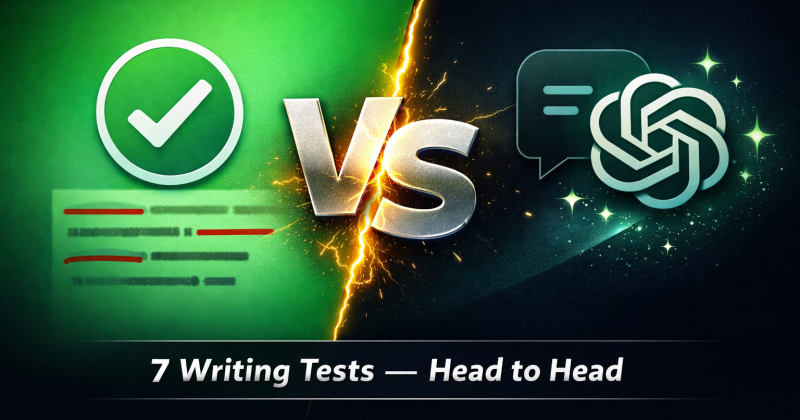
We put Grammarly vs ChatGPT through a head-to-head comparison across seven categories that matter most to writers: grammar correction, content generation, pricing, plagiarism detection, tone adjustment, workflow integration, and real-world writing quality. After two weeks of daily testing, the results surprised us — and the winner wasn’t who we expected.
If you’re also weighing other AI tools, our best AI writing tools roundup covers twelve options in detail. But for this specific showdown, let’s settle the debate.
Grammarly vs ChatGPT — Quick Comparison Table (2026)
Before the deep dive, here’s a snapshot of how these two tools compare right now.
| Feature | Grammarly | ChatGPT |
|---|---|---|
| Primary Purpose | Writing correction & editing | Content generation & AI assistant |
| Free Plan | Basic grammar, spelling, 100 AI prompts/mo | GPT-5.2 with ~10 messages/5 hours |
| Paid Price | $12/mo (annual) / $30/mo (monthly) | $20/mo (Plus) / $200/mo (Pro) |
| Grammar Checking | ★★★★★ Industry-leading | ★★★☆☆ Inconsistent |
| Content Generation | ★★★☆☆ Limited to rewrites & short drafts | ★★★★★ Full articles, blogs, scripts |
| Plagiarism Detection | ✅ Built-in (Pro plan) | ❌ Not available |
| Tone Detection | ✅ Real-time tone meter | ⚠️ Only if you ask |
| Browser Extension | ✅ Works everywhere — Gmail, Docs, social media | ❌ Requires separate tab or app |
| Long-Form Writing | ❌ Not designed for drafting full articles | ✅ Excellent — generates thousands of words |
| SEO Optimization | ❌ No SEO features | ✅ Can optimize for keywords, meta tags, structure |
| Image Generation | ❌ No | ✅ DALL-E built-in |
| Code Assistance | ❌ No | ✅ Full coding support |
| Parent Company | Grammarly Inc. (now part of Superhuman suite) | OpenAI |
| Users | 30 million+ | 700 million+ weekly active |
What Grammarly Actually Does in 2026
Grammarly started as a grammar checker in 2009. In 2026, it’s evolved into what the company calls an “AI communication assistant” — but at its core, it still does one thing better than any competitor: it catches mistakes in your existing writing and suggests improvements in real time.
The biggest change this year is the rebrand from Grammarly Premium to Grammarly Pro. The features remain the same, but Pro now includes team collaboration tools that were previously locked behind the Business plan. Individual writers get more for the same price.
Grammarly also became part of the Superhuman suite — a collection of AI tools that includes Superhuman Mail, Grammarly, and Coda. This integration means Grammarly now works even more seamlessly inside email and productivity workflows.
What Grammarly Pro Includes
The Pro plan ($30/month, or $12/month on annual billing) gives you everything the free version offers plus these features that matter for serious writers:
- Full-sentence rewrites — Grammarly doesn’t just flag problems. It rewrites entire sentences to improve clarity, conciseness, and flow.
- Tone suggestions — A real-time tone meter shows whether your writing sounds confident, friendly, formal, or urgent. You can adjust the target tone and Grammarly will reshape your phrasing to match.
- Plagiarism detection — Scans your text against billions of web pages and academic databases. Crucial for students and content creators.
- 2,000 AI prompts per month — Grammarly’s generative AI (GrammarlyGO) can draft short content, rewrite paragraphs, or generate ideas. Free users get 100 prompts/month.
- Brand tones and style guides — New in 2026. Set rules for your brand voice and Grammarly enforces them automatically across all team members.
- AI agents in Grammarly Docs — A new writing surface with built-in AI that offers feedback, revision tools, and citation help as you write.
What ChatGPT Actually Does in 2026
ChatGPT doesn’t check your grammar. It writes content from scratch, rewrites what you give it, brainstorms ideas, answers questions, generates images, creates code, and acts as a general-purpose AI assistant. For writers, it’s essentially a tireless co-author who works 24/7.
The 2026 version runs on GPT-5.2 (with GPT-5.4 Thinking available on Plus and Pro). The quality gap between ChatGPT and human writing has narrowed dramatically — especially for blog posts, social media content, marketing copy, and email drafts.
What ChatGPT Plus Includes ($20/month)
- GPT-5.2 with higher limits — 160 messages every 3 hours (vs. 10/5 hours on free)
- GPT-5.4 Thinking — Advanced reasoning model for complex writing tasks
- DALL-E image generation — Create custom images, thumbnails, and graphics
- Deep Research — Searches the web, analyses multiple sources, and produces structured research reports (10 runs/month)
- Custom GPTs — Build specialized writing assistants for specific content types
- File uploads — Analyse documents, PDFs, spreadsheets, and images
- Web browsing — Real-time internet access for current information
- Sora video generation — Create short videos from text (limited)
One important development: OpenAI started showing ads on Free and Go ($8/month) tiers in February 2026. Plus and Pro remain ad-free.
Round 1: Grammar and Error Correction — Clear Winner
This isn’t even close. Grammarly dominates grammar checking.
We tested both tools with a 1,000-word article containing 35 intentional errors — misspellings, comma splices, subject-verb disagreements, passive voice overuse, and inconsistent tense shifts.
Grammarly caught 33 out of 35 errors and suggested contextually appropriate fixes for each one. The corrections appeared instantly as we typed, with clear explanations for why each change was needed. The two errors it missed were highly stylistic choices that could reasonably go either way.
ChatGPT caught approximately 25 errors when we pasted the text and asked it to “proofread this article and fix all errors.” But here’s the problem: it also changed sentences that were already correct. It rewrote phrasing, altered our voice, and introduced new issues while fixing old ones. When we asked it to only flag errors without rewriting, it still struggled to resist making “improvements.”
For dedicated, reliable, real-time grammar checking — Grammarly wins this round decisively.
Round 2: Content Generation — Not Even a Contest
ChatGPT wins content generation by a landslide.
We asked both tools to “write a 1,500-word blog post about the benefits of journaling for mental health.”
ChatGPT produced a well-structured, engaging article in about 45 seconds. It included an introduction with a hook, organised sections with clear headings, relevant statistics, practical tips, and a conclusion with a call to action. The quality was publishable with light editing.
Grammarly’s GrammarlyGO generated roughly 300 words of generic content and then stopped. It’s designed for short-form generation — email drafts, paragraph rewrites, social media posts — not full-length articles. Even with the 2,000 monthly AI prompts on the Pro plan, each prompt generates a relatively small output.
If your primary need is writing content from scratch — blog posts, articles, marketing copy, scripts — ChatGPT is the only serious option here.
Round 3: Pricing — Who Gives You More for Less?
This comparison is trickier than it looks because you’re paying for fundamentally different things.
| Plan | Grammarly | ChatGPT |
|---|---|---|
| Free | Basic grammar, 100 AI prompts/mo | GPT-5.2 with tight message limits |
| Budget Paid | $12/mo annual ($144/yr) | $8/mo — Go plan (limited) |
| Standard Paid | $20/mo quarterly | $20/mo — Plus plan |
| Monthly | $30/mo | $20/mo — Plus plan |
| Premium | Enterprise (custom) | $200/mo — Pro plan |
At the same $20/month price point, ChatGPT Plus offers significantly more raw capability — content generation, image creation, research, coding, and web browsing. Grammarly Pro at $12/month (annual) is cheaper but only covers editing and short-form AI generation.
The real question is whether you need a creator (ChatGPT) or an editor (Grammarly). If you can only afford one, your workflow determines the answer.
Round 4: Plagiarism Detection — Grammarly Wins by Default
ChatGPT does not have a plagiarism checker. Period. If you paste text into ChatGPT and ask “is this plagiarised?”, it will give you a vague, unreliable answer based on pattern recognition — not an actual database scan.
Grammarly Pro includes a legitimate plagiarism detector that scans your text against billions of web pages and ProQuest’s academic database. It highlights matching passages and provides source links. For students, journalists, and content creators who need to verify originality, this feature alone can justify the subscription.
If plagiarism detection matters to your work, Grammarly is the only choice between these two.
Round 5: Tone and Style Adjustment — Closer Than You’d Think
Grammarly’s tone detection is passive and persistent. It runs in the background and shows a real-time tone meter as you write. You see exactly how your words come across — confident, friendly, diplomatic, constructive — without asking. You can set a target tone and Grammarly will actively flag sentences that don’t match.
ChatGPT’s tone adjustment is powerful but requires explicit prompting. You need to say “rewrite this in a casual, friendly tone” or “make this sound more professional.” It won’t proactively tell you that your email sounds passive-aggressive unless you ask. But when you do ask, the rewrites are often excellent — sometimes better than Grammarly’s suggestions because ChatGPT can restructure entire paragraphs rather than tweaking individual sentences.
Grammarly wins for passive, always-on tone awareness. ChatGPT wins when you want aggressive tone transformation of larger blocks of text.
Round 6: Integration and Workflow — Where You Write Matters
This is where Grammarly has a massive structural advantage that ChatGPT may never match.
Grammarly’s browser extension works everywhere — Gmail, Google Docs, WordPress, LinkedIn, Twitter/X, Slack, Notion, and virtually any text field on the web. It also has native apps for Windows, Mac, iOS, and Android. The corrections appear inline as you type, requiring zero context switching. You don’t leave your workflow.
ChatGPT requires you to either open a separate browser tab, use the desktop app, or use the mobile app. You write in ChatGPT’s interface and then copy the output to wherever you need it. There’s no inline correction inside Gmail or Google Docs. OpenAI has been testing integrations, but as of April 2026, ChatGPT’s ecosystem still requires you to leave your current workspace.
For writers who work inside email, Google Docs, or CMS platforms all day — Grammarly’s seamless integration is hard to beat.
Round 7: Real-World Writing Quality Test
We gave both tools the same assignment: “Rewrite this paragraph to make it more engaging and clear.” The original paragraph was deliberately mediocre — wordy, passive, and vague.
Original: “There are many different reasons why people who work in offices have been choosing to switch to working from home in recent years. It has been shown by research that productivity can be improved when employees are given the option to work remotely.”
Grammarly’s version: “Many office workers have switched to working from home in recent years. Research shows that remote work can improve productivity.”
ChatGPT’s version: “Office workers are leaving their cubicles behind — and the data backs them up. Studies consistently show that remote employees are more productive, more focused, and less likely to burn out than their in-office counterparts.”
Grammarly tightened the original. ChatGPT transformed it. Both improvements are valid, but they represent fundamentally different approaches — editing versus reimagining.
So Who Wins? The Honest Verdict
There is no single winner because Grammarly and ChatGPT solve different problems. Here’s our recommendation based on what you actually need:
Choose Grammarly If:
- You write your own content and need a safety net for grammar, spelling, and tone
- You work inside Gmail, Google Docs, WordPress, or Slack and need real-time corrections
- You need plagiarism detection for academic or professional work
- You want passive, always-on editing that doesn’t require prompting
- English isn’t your first language and you need reliable grammar support
Choose ChatGPT If:
- You need AI to write content from scratch — blog posts, articles, emails, scripts
- You want a brainstorming partner for ideas, outlines, and research
- You need a versatile tool that also handles images, code, and data analysis
- You create SEO-optimised content and need keyword integration, meta descriptions, and structured outlines
- You want the most powerful AI assistant available for $20/month
The Power Move: Use Both Together
The writers getting the best results in 2026 aren’t choosing between these tools — they’re stacking them. The workflow looks like this:
- ChatGPT generates the first draft, outline, or content structure
- You edit the draft with your own voice and expertise
- Grammarly polishes the final version — catching grammar errors, tightening sentences, checking tone, and running plagiarism detection
ChatGPT for creation. Grammarly for correction. Together, they cover the entire writing workflow from blank page to publish-ready content. If your budget allows both ($12/month Grammarly annual + $20/month ChatGPT Plus = $32/month total), that combination is genuinely hard to beat.
If you’re weighing Grammarly vs ChatGPT against other options too, our comparison of ChatGPT vs Claude covers the best alternative for pure writing quality, and our Rytr vs Writesonic breakdown helps if you’re looking at dedicated AI writing tools.
Grammarly vs ChatGPT for Specific Use Cases
Different types of writers have different needs. Here’s how the Grammarly vs ChatGPT decision plays out for specific use cases:
Bloggers and Content Creators: ChatGPT is the stronger choice. It generates outlines, writes full drafts, suggests headlines, creates meta descriptions, and can even produce social media captions to promote your post. Grammarly adds value as a final polish layer but won’t help you create from scratch.
Email and Business Communication: Grammarly wins here. Its browser extension corrects emails in real time inside Gmail and Outlook. The tone meter ensures your message strikes the right chord before you hit send. ChatGPT requires you to open a separate app, paste your email, and copy back the improved version — too many steps for quick replies.
Academic Writers and Students: Use both if possible. ChatGPT for research help and understanding complex topics. Grammarly for plagiarism checking, citation formatting, and ensuring your paper meets academic writing standards.
Freelance Writers: ChatGPT is typically the higher-ROI investment. It accelerates your output dramatically — turning a 4-hour blog post into a 1-hour project. Stack Grammarly’s free plan on top for basic grammar catching during the final edit pass.
Non-Native English Speakers: Grammarly Pro is arguably more valuable here. Its grammar corrections are precise and contextual, with explanations that help you learn over time. ChatGPT rewrites your text but doesn’t teach you why the original was wrong.
FAQ
Can ChatGPT replace Grammarly completely?
No. ChatGPT can generate and rewrite content, but it doesn’t offer real-time grammar checking inside your browser, email, or documents. It also lacks a dedicated plagiarism detector. If you need inline editing while you type, Grammarly is still necessary.
Is Grammarly worth paying for if I already have ChatGPT Plus?
Yes, if you write your own content regularly. ChatGPT generates drafts, but Grammarly catches the small errors that slip through — incorrect comma placement, inconsistent tone, passive voice overuse — in real time across every platform you write in.
Which is better for students — Grammarly or ChatGPT?
Both serve different needs. Grammarly’s plagiarism checker and grammar correction are essential for academic writing. ChatGPT helps with research, understanding concepts, and drafting. Most students benefit from Grammarly Free plus ChatGPT Free as a starting combination.
Does Grammarly use AI like ChatGPT?
Yes. Grammarly uses its own AI models for grammar correction and has added generative AI features through GrammarlyGO, which can draft short content and rewrite paragraphs. However, its AI is focused specifically on writing improvement, not general-purpose generation like ChatGPT.
Is ChatGPT good at grammar checking?
It catches obvious errors but is unreliable for thorough proofreading. In our testing, ChatGPT often changed correct sentences while fixing incorrect ones. It also tends to rewrite your voice rather than preserve it. For dedicated grammar checking, Grammarly is significantly more accurate and reliable.
Can I use Grammarly and ChatGPT together?
Absolutely — and this is the approach we recommend. Use ChatGPT to generate or brainstorm content, then run it through Grammarly for grammar, tone, and plagiarism checking. This combination covers the entire writing process from creation to polish.
Which tool is better for SEO content writing?
ChatGPT. It can research keywords, generate SEO-optimised outlines, write meta titles and descriptions, structure content with proper heading hierarchy, and produce full articles targeting specific search queries. Grammarly has no SEO features.